

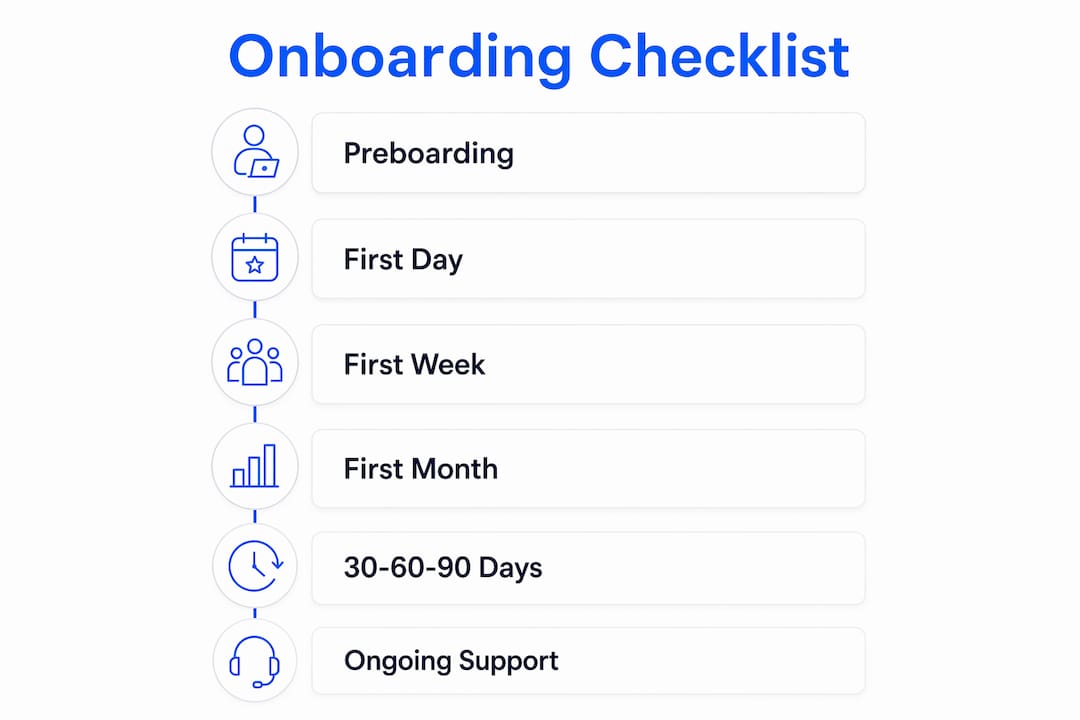
A solid onboarding checklist covers several distinct phases: preboarding, the first day, the first week, the first month, the initial months, and ongoing development beyond that. Each phase has specific tasks, clear owners, and measurable goals. Skip a phase and you don't just create confusion. You risk losing a new hire before they've had a real chance to contribute.
Here's what a complete employee onboarding checklist looks like at a glance:
- Preboarding: Send offer letter and tax forms, set up equipment and system access, assign a buddy or mentor, send a welcome email with first-day logistics
- First day: Office or virtual tour, introductions to the team, workspace setup, HR policy overview, benefits enrollment
- First week: Role clarity meeting with manager, initial training sessions, one-on-one with key stakeholders, culture and values discussion
- First month: Increasing task ownership, weekly check-ins with manager, continued role-specific training, 30-day performance conversation
- First 90 days: 30-60-90 day goal reviews, feedback sessions, cross-functional introductions, independent project ownership
- Beyond 90 days: Transition to a development plan, career path discussion, integration into long-term team rhythms
Two frameworks anchor every well-built new hire onboarding checklist. Dr. Talya Bauer's 5 Cs framework covers Compliance, Clarification, Confidence, Connection, and Culture. The 30-60-90 day plan structures how goals evolve from learning to contributing to leading. Together, they give HR teams a principled spine for every phase.
Table of Contents
- Your complete onboarding checklist, phase by phase
- What actually makes onboarding work
- How expert frameworks and technology strengthen your process
- Key Takeaways
- Why most onboarding programs underdeliver
- Webeonboarded gives HR teams a real system, not just a checklist
Your complete onboarding checklist, phase by phase
Structured onboarding checklists reduce voluntary turnover in the first six months by clarifying who does what and when. The breakdown below assigns ownership to HR, IT, the hiring manager, or a mentor so nothing falls through the cracks.
Preboarding (before the first day)
Preboarding shifts administrative work away from day one so the new hire can focus on people and culture from the moment they walk in.
HR owns:
- Send the signed offer letter and welcome packet
- Distribute I-9, W-4, direct deposit, and benefits enrollment forms
- Share the employee handbook and company policies
- Communicate first-day schedule, parking, dress code, and contact information
- Set up the new hire in payroll and HRIS systems
IT owns: 6. Provision laptop, phone, and any required hardware 7. Create email account, system logins, and software licenses 8. Test VPN and remote access if applicable
Manager owns: 9. Send a personal welcome message or video 10. Assign an onboarding buddy or mentor 11. Prepare the workspace or virtual setup 12. Brief the team on the new hire's role and start date
First day
The goal on day one is simple: make the new hire feel expected, not surprised.
HR owns:
- Conduct a formal orientation covering benefits, policies, and compliance requirements
- Collect any outstanding paperwork
- Review the employee handbook and code of conduct
Manager owns: 4. Introduce the new hire to the immediate team and key stakeholders 5. Walk through the role, initial priorities, and 30-day expectations 6. Give a tour of the office or a virtual walkthrough of tools and channels 7. Schedule recurring one-on-ones for the first 90 days
Buddy/Mentor owns: 8. Take the new hire to lunch or schedule a virtual coffee chat 9. Answer informal questions about team culture and unwritten norms

First week
Role clarity is the priority this week. A new hire who doesn't understand their responsibilities by Friday of week one will spend the next month guessing.
Manager owns:
- Hold a dedicated role-clarity meeting covering goals, success metrics, and reporting structure
- Introduce the new hire to cross-functional partners they'll work with regularly
- Review tools, workflows, and communication norms
HR owns: 4. Confirm all paperwork is complete and filed 5. Check in briefly to surface any logistical issues
New hire owns: 6. Complete any assigned compliance or role-specific training modules 7. Schedule introductory meetings with key colleagues

First month
By the end of month one, the new hire should be handling real work, not just observing it.
Manager owns:
- Conduct a 30-day check-in covering early wins, challenges, and goal alignment
- Assign a meaningful project or responsibility with clear scope
- Provide specific, timely feedback on early performance
HR owns: 4. Send a 30-day pulse survey to gather the new hire's experience 5. Confirm benefits enrollment is finalized 6. Review training completion rates
Mentor owns: 7. Check in on social integration and team dynamics 8. Help the new hire navigate any cultural or process questions
First 90 days (the 30-60-90 day plan)
The 30-60-90 day plan is the most widely used framework for structuring this phase. Goals shift from learning to contributing to owning.
Days 1–30 (Learn):
- Understand the team's goals, priorities, and current projects
- Shadow key processes and workflows
- Build relationships with direct colleagues and stakeholders
Days 31–60 (Contribute): 4. Take ownership of defined tasks or a small project 5. Participate actively in team meetings and decisions 6. Identify one area for process improvement
Days 61–90 (Own): 7. Lead a project or initiative independently 8. Complete a formal 90-day performance review with the manager 9. Set goals for the next quarter
HR owns throughout: 10. Schedule 60-day and 90-day check-ins 11. Track training completion and flag gaps 12. Gather feedback from the manager on new hire progress
Beyond 90 days
Effective onboarding is not a single event. It's a continuous process that shapes long-term engagement and performance. After 90 days, the focus shifts from integration to development.
- Transition the new hire to a formal performance management cycle
- Conduct a career path conversation covering growth opportunities
- Integrate the employee into long-term team planning and goal-setting
- Archive onboarding records and close out the checklist in your HR system
What actually makes onboarding work
Most onboarding programs fail not because the checklist is wrong, but because no one follows it consistently. These practices close that gap.
- Set expectations before day one. New hires who receive a clear agenda and first-week schedule before they start arrive less anxious and more prepared to engage.
- Assign a buddy, not just a manager. Peer mentors answer the questions new hires are too nervous to ask their boss. That informal channel accelerates cultural integration faster than any formal training session.
- Schedule check-ins at 30, 60, and 90 days. Put them on the calendar during preboarding. If they're not scheduled, they don't happen.
- Tailor the checklist to the role. A remote software engineer and an in-person sales rep need different first weeks. Generic onboarding treats everyone the same and serves no one particularly well.
- Gather feedback at every milestone. A 30-day pulse survey takes five minutes to complete and surfaces problems before they become turnover.
- Define task ownership explicitly. Clear ownership across HR, IT, and the hiring manager prevents the most common onboarding failure: everyone assuming someone else handled it.
Pro Tip: Automate the administrative layer. Welcome emails, form reminders, and equipment requests can all be triggered automatically when a new hire is added to your system. That frees HR to focus on the human side of onboarding, which no software can replace.
How expert frameworks and technology strengthen your process
The 5 Cs framework by Dr. Talya Bauer
Dr. Talya Bauer's 5 Cs framework gives HR teams a research-backed lens for evaluating whether onboarding is actually working. Each "C" represents a dimension of integration that a checklist should address:
- Compliance: Legal and policy requirements, forms, and mandatory training
- Clarification: Role expectations, goals, and performance standards
- Confidence: Building the new hire's belief that they can succeed in the role
- Connection: Relationships with colleagues, managers, and the broader organization
- Culture: Understanding the company's values, norms, and unwritten rules
Most onboarding programs cover Compliance well. They struggle with Confidence and Culture, which are harder to put on a checklist but matter most for long-term retention.
The 30-60-90 day plan in practice
The 30-60-90 day structure works because it matches the natural arc of how people learn a new job. The first 30 days are about absorbing information without the pressure to perform. Days 31–60 introduce real contribution. By day 90, the new hire should be operating with enough independence to own outcomes, not just tasks. Managers who skip straight to ownership in week two create anxiety. Those who stay in "learning mode" past day 60 create boredom and disengagement.
What onboarding technology actually changes
Onboarding software doesn't replace the human side of integration. It removes the administrative friction that gets in the way of it. When HR isn't chasing paperwork, they can spend that time on the conversations that actually build retention.
Onboarding platforms like Webeonboarded centralize every task, document, and deadline in one place. HR admins assign tasks to the right owners, track completion in real time, and see where the process is stalling before it becomes a problem. New hires get their own portal with a clear view of what's expected and when. That two-sided visibility is what separates a managed process from a spreadsheet that someone updates occasionally.
Webeonboarded's analytics dashboard breaks down completion rates by department, so HR can identify which teams are consistently behind on onboarding tasks and address the root cause rather than chasing individuals. Reusable templates mean you build the checklist once and deploy it for every new hire in that role, with adjustments for department or location as needed.
Key Takeaways
A phased onboarding checklist covering preboarding through the initial months, with clear task ownership and structured check-ins, is the most reliable way to reduce early turnover and accelerate new hire productivity.
| Point | Details |
|---|---|
| Six-phase structure | Cover preboarding, day one, week one, month one, 90 days, and beyond for full integration. |
| Clear task ownership | Assign every checklist item to HR, IT, the manager, or a mentor to prevent missed steps. |
| 30-60-90 day goals | Progress new hires from learning to contributing to owning outcomes across the first quarter. |
| 5 Cs framework | Use Dr. Talya Bauer's Compliance, Clarification, Confidence, Connection, and Culture model to audit gaps. |
| Webeonboarded | Centralizes task tracking, automates workflows, and provides department-level analytics for HR teams. |
Why most onboarding programs underdeliver
The conventional wisdom says onboarding is an HR problem. Build a better checklist, train the managers, and the retention numbers will follow. That framing misses the real issue.
Onboarding fails most often because the people responsible for executing it, managers, are also the people with the least time and the fewest tools to do it well. They're running a team, hitting targets, and managing their own workload. A PDF checklist emailed on the new hire's start date is not a system. It's a suggestion.
What actually works is treating onboarding the way a military operation treats a mission brief: clear objectives, defined roles, a timeline, and a mechanism for tracking whether each step happened. That's not a metaphor. The discipline of breaking a complex process into phases with explicit ownership is exactly what separates organizations with strong retention from those that lose people in the first six months.
The 5 Cs framework and the 30-60-90 day plan are useful precisely because they force that discipline. They don't just tell you what to do. They tell you what to measure. And when you combine that structure with a platform that tracks completion and surfaces gaps automatically, you stop relying on memory and goodwill to run a process that directly affects whether your new hires stay.
One more thing worth saying plainly: onboarding is not done at day 90. The 90-day mark is when formal onboarding ends and real integration begins. The organizations that treat day 91 as "you're on your own now" are the same ones wondering why their retention numbers look the way they do.
Webeonboarded gives HR teams a real system, not just a checklist
Every phase in this guide requires coordination across HR, IT, managers, and mentors. Without a central system, that coordination depends on email threads, calendar reminders, and someone remembering to follow up. That's where most onboarding programs quietly break down.
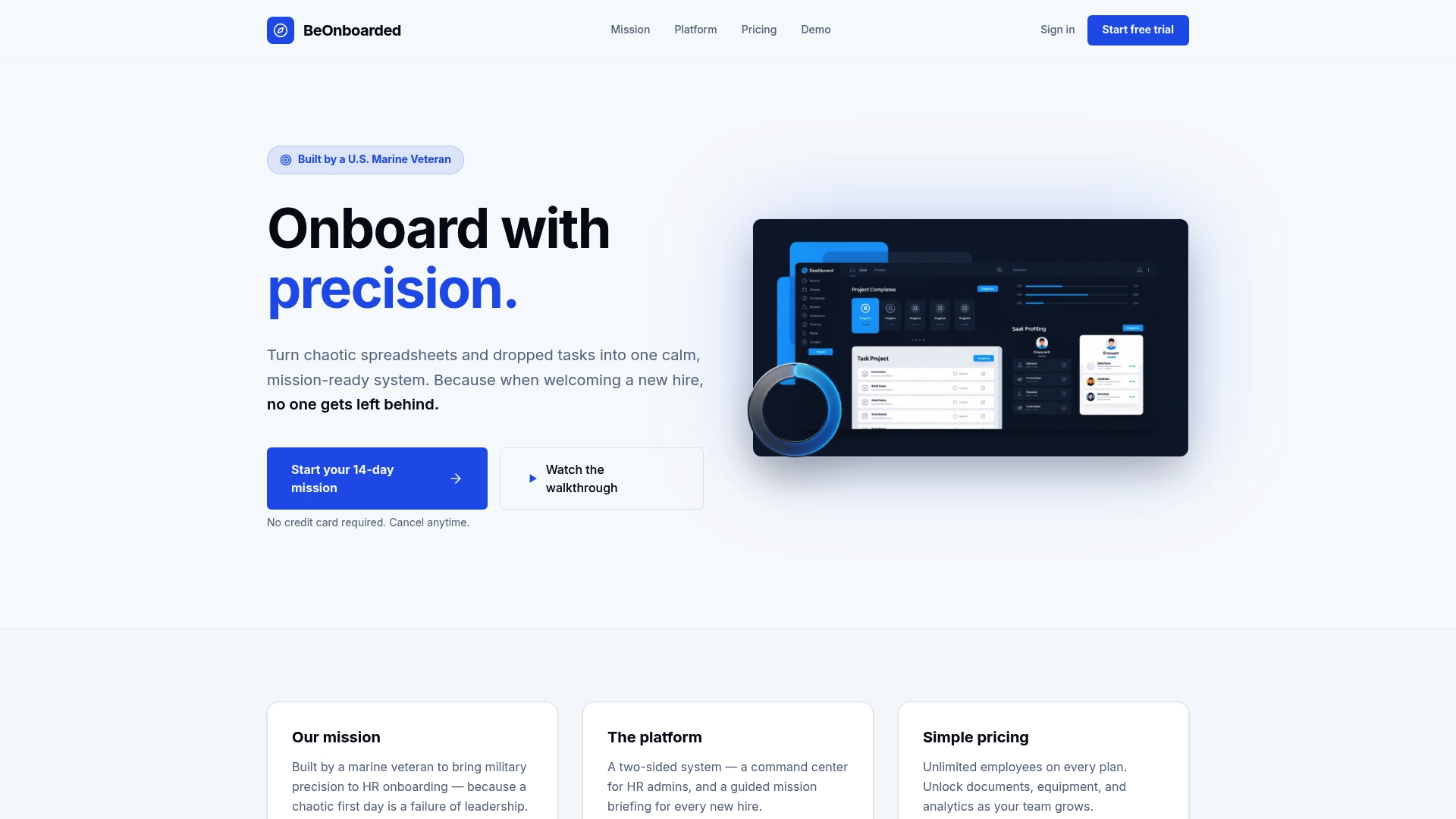
Webeonboarded was built specifically for this problem. Created by a U.S. Marine Veteran, the platform brings the same operational discipline to HR onboarding that the military applies to mission execution. HR admins get a centralized dashboard to assign tasks, track completion, and monitor progress across every new hire simultaneously. New employees get their own portal with a clear view of what's expected, when it's due, and who to contact. The two-sided system means both sides of the onboarding relationship stay aligned from day one through day 90 and beyond.
Every plan includes unlimited employee integration, so your cost doesn't scale with headcount. Reusable templates let you build a role-specific checklist once and deploy it consistently. The analytics dashboard shows completion rates by department, so you can see exactly where the process is breaking down before it costs you a hire.
Start your 14-day free trial and see what a managed onboarding process looks like when the administrative work runs itself.